
Foundation Repair Methods, Explained in Plain Language
When a contractor proposes "underpinning with steel push piers" or "interior perimeter drainage", it helps to know what those phrases actually mean before you agree to anything. This page explains the main foundation repair methods explained in everyday terms: what each method does, which problems it suits, and what its limitations are. No method is universally best; the right choice depends on your soil, your symptoms and your house.
Push Piers (Resistance Piers)
Push piers are the workhorse of settlement repair. Steel pier sections are hydraulically driven into the ground beside the footing until they reach stable soil or bedrock, using the weight of the house itself as the reaction force. Brackets then connect the piers to the footing, transferring the load down to the stable layer. Once all piers are in place, the foundation can sometimes be lifted back towards its original position, though stabilisation, preventing further movement, is the more realistic goal.
Push piers suit heavier structures and are widely used across the Tri-Cities, where limestone bedrock often provides excellent end-bearing at depth. Their main limitation is that they need sufficient structural weight to drive against, and very deep installations add cost. Typical pricing runs $1,500 to $3,000 per pier installed.
Helical Piers
Helical piers look like giant screws: steel shafts with helical plates that are rotated into the ground with hydraulic equipment. Because they are screwed rather than pushed, they do not need the building's weight for installation, which makes them ideal for lighter structures, porches, decks and new construction. An engineer can verify their load capacity during installation by measuring the torque required to advance them.
In East Tennessee's variable soils, helical piers are a good fit where bedrock is deep or where the structure is too light for push piers. They generally cost a little more per unit, typically $1,800 to $3,500 installed, but the installation is precise and immediately loadable.
Wall Anchors and Carbon Fibre Straps
Basement walls that bow inward under soil pressure need lateral restraint, not underpinning. Wall anchors solve this with steel plates: one plate inside against the wall, one buried out in the yard, connected by a steel rod. Tightening the rod over time can gradually straighten the wall. The method requires enough clear yard beyond the wall for the exterior plate, which is not always available on tight Tri-Cities lots.
Carbon fibre straps are the lower-profile alternative. High-strength carbon fibre sheets are bonded vertically to the interior face of the wall with epoxy, creating a reinforcement far stronger than the masonry itself. Straps are excellent for stabilising walls with minor bowing, typically costing $1,500 to $4,000 or more per wall, but they cannot straighten a wall that has already moved significantly. For severe bowing, anchors or partial rebuilding remain the honest recommendation.
Crack Injection
Non-structural cracks in poured concrete walls are commonly sealed by injecting epoxy or expanding polyurethane directly into the crack. Epoxy restores the wall's original strength across the crack; polyurethane remains slightly flexible and is better where minor ongoing movement is expected. Injection is a repair for the crack itself, not for the settlement that may have caused it, so it should be paired with an assessment of why the crack appeared. Expect $500 to $1,500 for typical residential crack injection.
Drainage and Waterproofing Systems
A large share of Tri-Cities foundation work is really water management. Interior perimeter drainage, often called a French drain, collects water that enters at the wall-footing joint and channels it to a sump pump, typically costing $4,000 to $10,000. Exterior waterproofing goes further: excavating around the foundation, applying a waterproof membrane and installing exterior drains, which is highly effective but disruptive and expensive at $8,000 to $20,000 or more.
Before either, the basics deserve attention: gutters, downspout extensions, grading and keeping water away from the foundation solve many damp basements without any excavation at all. Any contractor who proposes a $15,000 interior system before asking about your gutters is selling, not diagnosing.
Crawl Space Support and Encapsulation
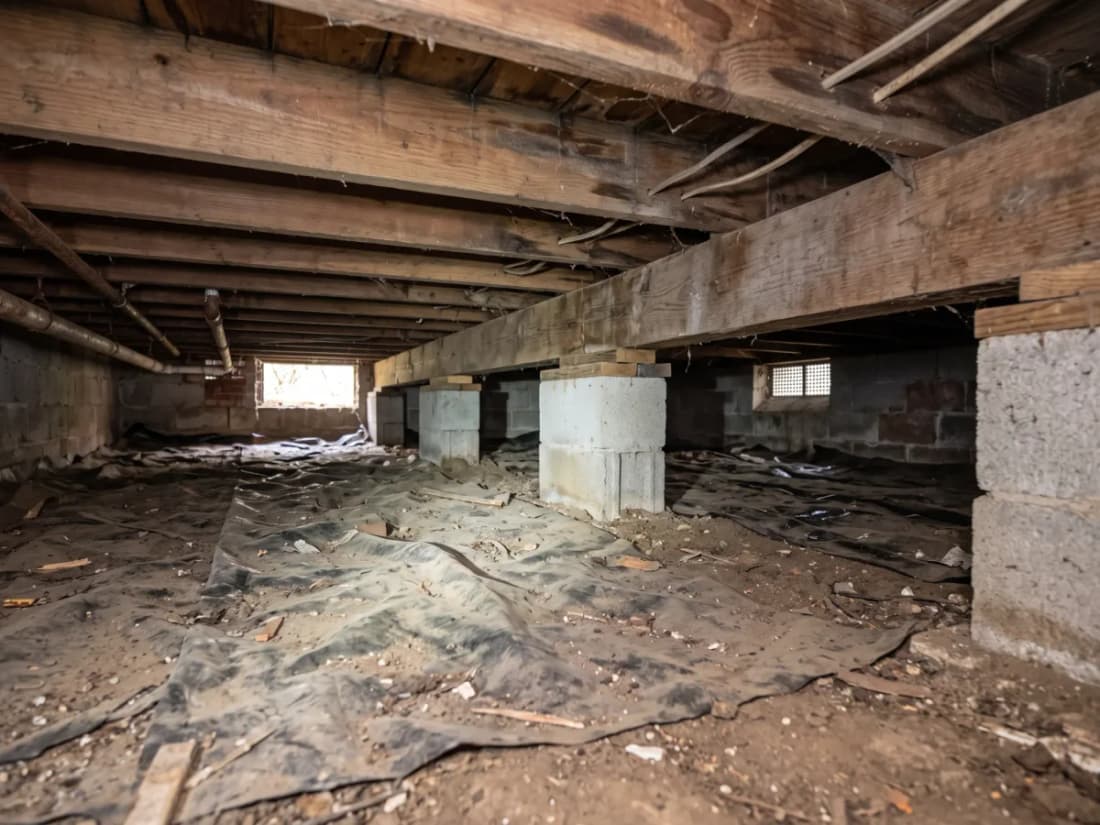
Many Tri-Cities homes sit over crawl spaces rather than full basements. Sagging floors here are usually addressed with supplemental beams and adjustable steel jacks, sometimes called crawl space jacks, which lift and re-level the floor structure; full systems typically run $5,000 to $12,000 or more. Where moisture is the underlying enemy, encapsulation, sealing the crawl space with a heavy vapour barrier, conditioned air and drainage matting, protects both the structure and the indoor air quality above it.
Matching method to problem: settlement calls for piers, bowing walls call for anchors or carbon fibre, leaking walls call for drainage, and sagging floors call for crawl space support. A proposal that does not clearly connect the method to your diagnosed problem deserves a second opinion.
Getting a Proper Assessment
The method matters less than the diagnosis behind it. A trustworthy assessment starts with a full walk-around, inside and out, including the crawl space or basement, and ends with a plain-language explanation of what is moving, why, and what the proposed fix will achieve. If you would like help with foundation repair in Johnson City, TN who works this way, referral resources exist for exactly that purpose. You can also browse general homeowner guidance anytime at Tri-Cities Foundation Repair Help.